


A Chartered Professional Engineer (CPEng) is a practitioner who has been independently assessed as meeting an internationally recognized standard of competence. This title is a protected quality mark under the Chartered Professional Engineers New Zealand Act 2002.
Holding this credential indicates that an engineer can resolve complex engineering problems requiring expert technical knowledge. The designation provides assurance to regulatory bodies, clients, and the public that the professional maintains current industry best practices and adheres to a strict Code of Ethical Conduct.
CPEng status serves as a validation of specialized expertise. While registered in New Zealand, the credential carries international mobility due to its alignment with global engineering accords. To retain this title, registered individuals must undergo regular competency reassessments.
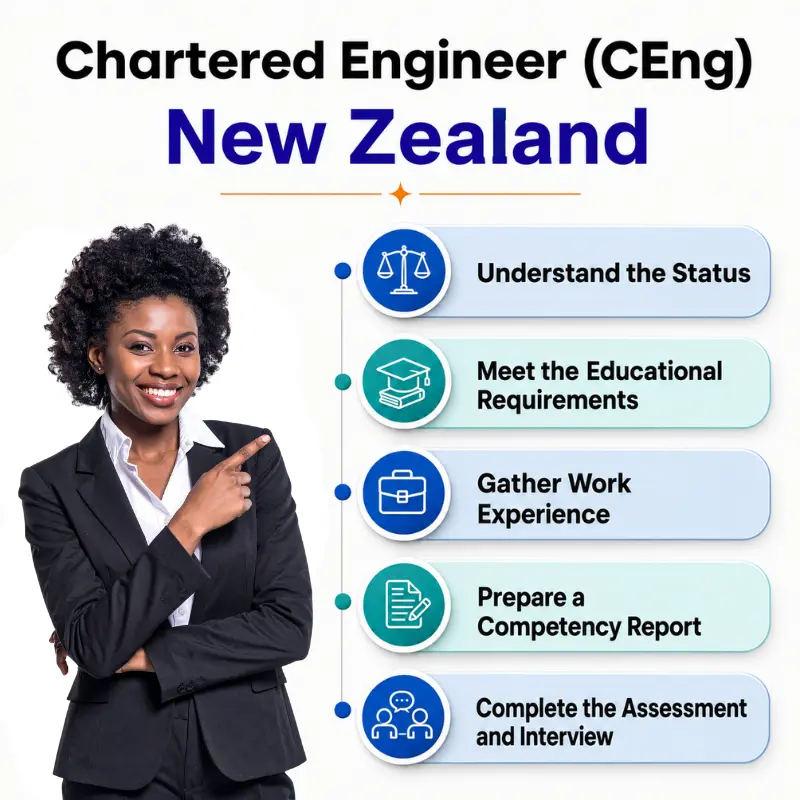
Core Prerequisites for CPEng Registration with Engineering NZ
Before initiating an application, a candidate must satisfy foundational academic and professional criteria. Meeting these benchmarks ensures the applicant possesses the necessary theoretical framework and practical experience to undergo formal assessment.
- Qualification: A Washington Accord accredited engineering degree (typically a four-year Bachelor of Engineering with Honours) or equivalent demonstrated knowledge.
- Competency: Sufficient evidence of managing complex engineering activities and solving complex problems.
- Ethics: A formal commitment to abide by the CPEng Code of Ethical Conduct.
- Currency: Willingness to undergo mandatory competency reassessments at least every six years.
The CPEng Application Process
The application is managed through an online portal and follows a structured evaluation sequence. This process requires the submission of documented evidence detailing the engineering projects and decisions the applicant has executed.
Initial Portfolio Compilation
Applicants must compile a detailed portfolio of evidence. This documentation includes a work history report, specific engineering project files, and proof of continuing professional development. The material must explicitly demonstrate how the candidate meets the twelve established competency standards, particularly in risk management, local technical regulations, and engineering synthesis.
Drafting and Preliminary Review
Before formal submission, candidates submit a draft application through the portal. An assessment coordinator reviews the documentation to identify gaps or areas requiring clarification. This administrative check helps ensure the portfolio contains sufficient detail for the technical evaluation stage.
Peer Evaluation and Professional Review
Once finalized, the application is assigned to an assessment panel consisting of experienced peer engineers. The evaluation involves multiple distinct stages designed to test the applicant’s competence rigorously.
| Stage | Process Component | Objective |
| 1 | Portfolio Assessment | Panel reviews the submitted technical data and referee validations. |
| 2 | Professional Interview | The candidate attends a meeting to discuss technical decisions and ethical scenarios. |
| 3 | Recommendation | Panel drafts a report for the Competence Assessment Board (CAB). |
| 4 | Final Decision | The CAB reviews the report and grants or denies registration. |
Maintaining Chartered Status
Registration is not a permanent accolade. To ensure public safety and technical relevance, engineers must actively maintain their competence. The Registration Authority monitors this through the statutory six-yearly reassessment cycle, during which professionals must demonstrate they have continued to practice competently within their specified practice area.